A short history of SOLAS and the Marine Equipment Directive — and why the sticker on your life raft says what it says.
Every piece of survival equipment we service carries a chain of approvals that reaches back more than a century. Understanding where those rules came from makes it easier to understand what an inspection is actually checking, why service intervals are what they are, and why some equipment is accepted in one country and not another.
SOLAS: born from the Titanic

The International Convention for the Safety of Life at Sea began as a direct response to the loss of RMS Titanic in April 1912. British regulations at the time based lifeboat capacity on a ship’s tonnage rather than the number of people aboard, and Titanic was fully compliant while carrying boats for roughly half the people she had on board. Public outrage led thirteen maritime nations to meet in London.

- 1914The first SOLAS convention is signed in London on 20 January by thirteen nations, twenty-one months after Titanic. It applies to passenger ships on international voyages and is organised into five parts that every later convention has kept in some form:
- Safety of navigation. Ships must report ice, derelicts and storms by radio; must slow down or alter course at night when ice is reported ahead; and the North Atlantic ice patrol is created, funded by the signatories. Distress signals are standardised — rockets at night mean distress and nothing else.
- Construction. Watertight subdivision is set by a “floodable length” calculation: bulkheads must be spaced so the ship survives flooding of any two adjacent compartments, and they must extend high enough that water cannot spill over the top. Bulkhead doors, fire detection and fire extinguishing arrangements are specified.
- Radiotelegraphy. Ships carrying fifty or more people must carry wireless, with a continuous watch on the larger ships and a backup power supply so the set works if the main plant fails.
- Life-saving appliances. Lifeboats and rafts for every person aboard, to be swung out and lowered in a set time; boat drills and assigned boat stations for crew; lifejackets for everyone; and a trained lifeboatman for each boat.
- Certificates. A government-issued safety certificate, recognised by the other signatories, showing the ship complies — the ancestor of the survey and certification system that governs commercial vessels today.
- 1929A second convention, this time adopted by eighteen nations, carries the 1914 ideas into force and adds rules on construction, watertight subdivision, and fire protection.
- 1948The third convention absorbs wartime lessons and expands fire safety and stability requirements. The same year, the United Nations creates the body that will later become the International Maritime Organization (IMO).
- 1960The first SOLAS convention drafted under the IMO’s own roof. Inflatable life rafts, still a novelty, gain formal recognition as survival craft.
- 1974The convention still in force today. Its key innovation is “tacit acceptance”: amendments take effect on a set date unless enough nations object, which is why SOLAS has been updated dozens of times since without a new convention.
- 1983A rewritten Chapter III sets modern standards for life-saving appliances — including the requirement that inflatable life rafts be serviced at an approved servicing station.
- 1998The Life-Saving Appliance (LSA) Code takes effect, moving the detailed technical specifications for rafts, lifejackets, immersion suits, and other equipment out of the convention text and into a code that can be updated more easily.
The Marine Equipment Directive: Europe’s answer to “approved by whom?”
SOLAS says what equipment must do, but leaves it to each flag state to approve the equipment that does it. By the 1990s that meant a manufacturer selling into Europe might need separate approvals from a dozen national administrations. The European Union’s answer was the Marine Equipment Directive.
- 1996Directive 96/98/EC is adopted. It applies from 1 January 1999. Equipment tested to the international standards it lists and certified by an EU notified body can be placed on any EU-flagged ship, marked with the “wheelmark” — a ship’s wheel symbol that is the maritime cousin of the CE mark.
- 2004The United States and the EU sign a mutual recognition agreement. For listed categories of equipment, a wheelmarked product is accepted by the US Coast Guard, and a USCG-approved product is accepted in the EU, without duplicate testing.
- 2014Directive 2014/90/EU replaces the original. Applying from 18 September 2016, it tightens market surveillance, allows electronic tagging of approved equipment, and moves the technical requirements into an implementing regulation that the Commission updates annually as the IMO standards change.
What the rules require aboard
SOLAS Chapter III and the LSA Code spell out the survival equipment a ship must carry. The list depends on ship type, size, and route, but for a typical vessel it comes down to these items — each of which must be an approved type, and several of which must be inspected or serviced on a fixed schedule.

Inflatable life rafts
Capacity for everyone aboard, in deck canisters with hydrostatic releases so they float free if the ship goes down. This Survitec Zodiac SOLAS ‘A’ raft is serviced every 12 months.
Shop life rafts →
Immersion suits
One per person on ships in cold waters, with thermal protective aids for the rest. Required since the 1983 amendments after the Ocean Ranger and Marine Electric losses.
Shop immersion suits →
Raft rations and equipment
Packed inside every SOLAS raft: water rations, food, flares, a repair kit, signalling mirror, and first aid — all with expiry dates checked at service.
Shop emergency rations →
Lifejackets
One for every person plus spares for watchkeepers and children, each with a light and whistle. Inflatable types, like this Kent A/M-33, need annual inspection.
Visit our store →
Distress beacons
A satellite EPIRB — this one an ACR GlobalFix — that floats free and transmits the ship’s identity and position, plus radar transponders for the survival craft: the modern descendants of Titanic’s wireless.
Visit our store →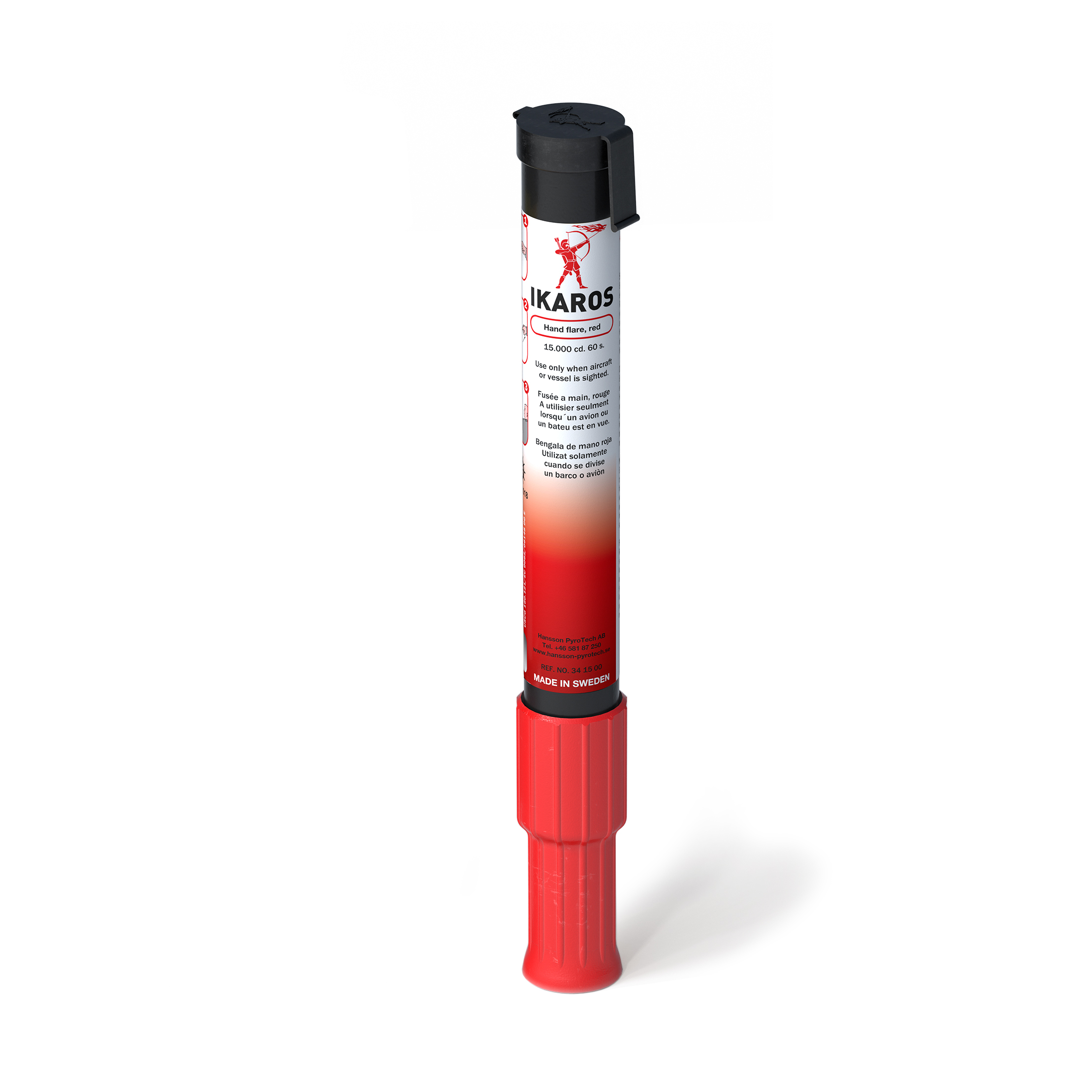
Flares and rockets
Rocket parachute flares, hand flares like this IKAROS, and smoke signals on the bridge and in each survival craft, all date-limited and replaced before expiry.
Visit our store →Product photos: Survitec Zodiac, Kent Safety Products, ACR Electronics, and IKAROS (Hansson PyroTech).
How it fits together
SOLAS & the LSA Code
The international performance standard: what a life raft must survive, how many people it must hold, what must be packed in it. Set by the IMO, agreed by flag states.
MED (wheelmark)
Europe’s single approval system proving a piece of equipment meets those SOLAS standards. One test, one certificate, valid across the EU and — for many items — recognized by the USCG.
USCG approval
The US approval system, under Title 46 of the Code of Federal Regulations. Required for equipment on US-flagged inspected vessels; reciprocal with the MED for listed items.
Approved servicing
A raft is only as good as its last service. Manufacturer authorization plus flag-state or class approval of the station is what keeps a SOLAS raft’s certificate valid.
What this means for a boat owner
If you operate a commercial or inspected vessel, your rafts and equipment must carry the approval your flag state recognizes — USCG approval for a US-flagged vessel — and must be serviced on schedule at a station approved for that make. The service certificate is part of the vessel’s inspection record.
If you operate a recreational boat, none of this is legally required in most cases, but it is still the yardstick. A SOLAS or wheelmarked raft has passed drop, inflation, seakeeping, and material tests that a recreational raft may not. Knowing the difference helps you decide what level of protection you’re buying, and how often it needs to be opened up and looked at.
Go deeper
Titanic: the night the rules changed
The sinking, the inquiries, and exactly what each finding became in law.
The disasters behind the rules
Morro Castle to Costa Concordia — the losses that drove each round of amendments.
Before modern safety standards: early safety at sea
Cork lifejackets, the first lifeboats, the Lyle gun, and the Plimsoll line.
Morro Castle, 1934
The burning liner off New Jersey that reshaped US fire safety and crew training rules.
Sources: International Maritime Organization, SOLAS Consolidated Edition and the history of SOLAS; IMO Resolution A.761(18) as amended by MSC.55(66) and MSC.388(94); European Commission, Directives 96/98/EC and 2014/90/EU; US Coast Guard, 46 CFR Subchapter Q; US–EU Mutual Recognition Agreement on Marine Equipment (2004).